Quick Summary
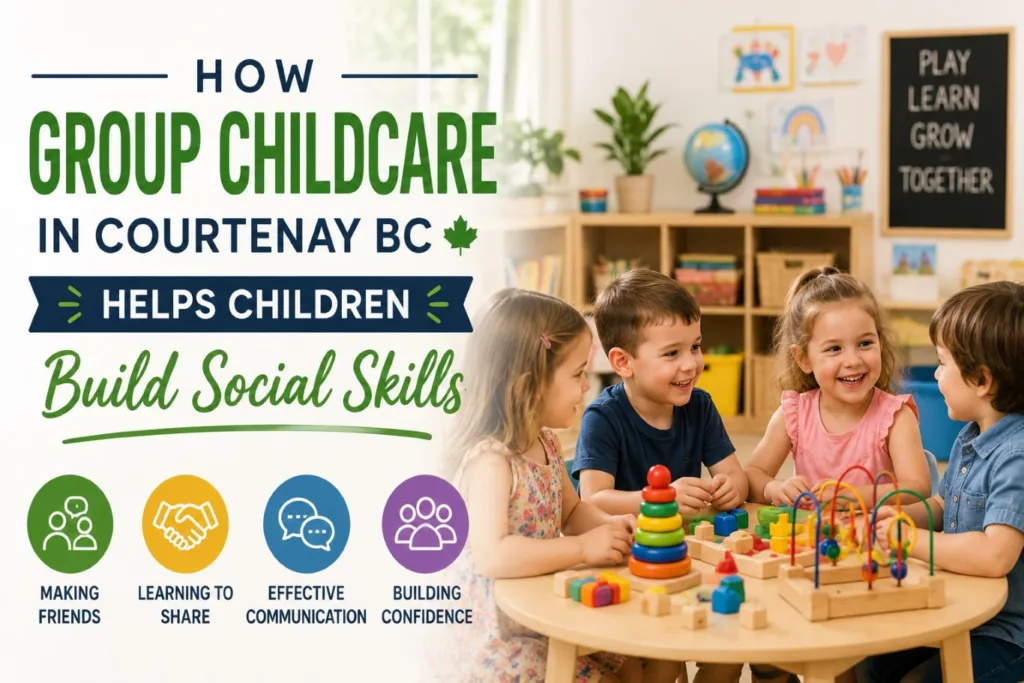
- Enrolling in a structured group childcare in Courtenay BC helps children transition from individual focus to collaborative peer socialization.
- The 3-to-5 age window is a critical developmental phase where children learn foundational conflict resolution, empathy, and active sharing.
- Group dynamics naturally foster communication skills, confidence, and early childhood emotional regulation.
- Structured play-based programs prepare children for the collaborative routines of local Kindergarten classrooms (SD71).
- Discover how professional community spaces like Sitka Spruce Daycare design interactive group play to support social-emotional milestones.
Introduction
The years between ages three and five are a remarkable window of human transformation. During this phase, a child’s world expands from the immediate family circle to include a genuine interest in the peers around them. They transition from “parallel play”—simply playing side-by-side without interacting—to complex, collaborative games that require communication, negotiation, and teamwork. For families in the Comox Valley, providing opportunities to practice these emerging capabilities is essential for building lifelong confidence. Enrolling your child in a reputable group childcare in Courtenay BC offers a natural environment where these complex interpersonal interactions can be safely explored. Professional and customer-focused centres, such as Sitka Spruce Daycare, curate group childcare programs specifically for 3-to-5-year-olds, establishing a structured community where early learning and intentional socialization walk hand-in-hand.
Ready to see how our interactive group spaces help your child build lasting friendships and social confidence?
The Dynamics of Group Socialization in Early Years
When a child enters a group care environment, they are stepping into their very first micro-society. At home, a child is naturally the center of adult attention, and their specific desires are anticipated quickly. In a classroom cohort alongside multiple peers, the social dynamic shifts completely.
Children suddenly discover that others have differing perspectives, unique feelings, and competing desires for the exact same toy. This realization is a massive cognitive milestone known to child psychologists as the development of Theory of Mind—the ability to attribute mental states to oneself and others. Navigating this shift successfully requires consistent practice, emotional buffering, and the mature guidance of early childhood professionals who know how to turn everyday playground moments into profound social lessons.
1. Mastering the Art of Cooperation and Sharing
To a four-year-old, the concept of sharing can feel incredibly vulnerable. It requires a level of impulse control that their brains are only just beginning to develop.
In a dedicated group environment, sharing is never forced as a rigid command; instead, it is introduced through structured cooperation. Whether children are collaborating to build a sprawling wooden train track, working together on a floor puzzle, or managing roles in a dramatic play kitchen, they discover a vital truth: working together makes the game more fun.
Educators use positive reinforcement to highlight these successful moments, saying things like, “Look how tall your tower grew because you both worked together to stack the base blocks!” Over time, this shifts the child’s perspective from protective individualism to joyful collaboration.
2. Conflict Resolution and Emotional Self-Regulation
Where young children gather, conflict will naturally arise—and that is a highly valuable part of the learning process. A disagreement over who gets to hold the green shovel in the sandbox isn’t a failure of the program; it is a live learning opportunity.
Moving Past Reactivity
In an unmonitored or unstructured setting, children often resort to physical reactivity, such as grabbing, pushing, or emotional outbursts, when faced with social friction. In a structured centre, Registered Early Childhood Educators (ECEs) step in as emotional co-regulators. They help children slow down, take deep breaths, and identify their big feelings.
Using Words to Solve Problems
Educators teach children explicit scripts to advocate for themselves and respect their peers. A child is guided to say, “I am using this toy right now, but you can have it when my timer rings,” or “It hurts my feelings when you push past me in line.” By practicing these communication tools daily, children develop internal emotional regulation and learn that conflicts can be resolved calmly through clear, respectful dialogue.
3. Empathy, Kindness, and Prosocial Behaviors
Empathy—the capacity to step into another person’s shoes and feel what they are feeling—is not a completely automatic human reflex; it is a learned capacity that requires observation and consistent modeling.
A group childcare setting provides a rich environment for cultivating these prosocial behaviors. When a peer falls on the outdoor turf or feels sad during morning drop-off, educators draw the group’s attention to it gently: “Look at your friend’s face; they look sad because they miss their mom. What can we do to help them feel welcome?”
Children witness their peers offering a comforting hand, sharing a plush toy, or inviting a lonely friend into a game. These daily experiences build a deep sense of community responsibility, transforming young children into compassionate, kind companions who value the well-being of the group.
4. Conversational Competence and Linguistic Confidence
Language flourishes when it has a clear, compelling social purpose. While talking with adults is important for vocabulary acquisition, talking with peers is what truly polishes a child’s conversational confidence.
During structured group interactions—such as morning circle meetings, family-style lunch periods, and collaborative art projects—children are constantly practicing the complex mechanics of reciprocal dialogue. They learn to listen attentively without interrupting, interpret non-verbal facial expressions, modify their tone of voice to match the social context, and clarify their thoughts when a peer doesn’t understand them. For children who are naturally quiet or hesitant, the warm, low-pressure dynamic of a peer group often provides the exact encouragement they need to find their voice and state their thoughts with clarity.
Navigating Local Choices: Subsidies and Family Supports
Securing an early learning program that perfectly balances rich social opportunities with a sustainable family budget is a top priority for Comox Valley parents. Finding an affordable daycare in Courtenay BC that maintains exceptional standards of care is highly achievable today due to ongoing provincial funding modernizations.
When exploring your local options, it is highly beneficial to select a fully licensed daycare in Courtenay BC that is actively enrolled in the universal Child Care Fee Reduction Initiative (CCFRI). Under this provincial program, funding is delivered directly to the childcare provider to lower monthly tuition rates for families automatically. For children enrolled in full-time group care within the 3-to-5 age bracket, this universal discount provides significant, permanent relief.
Furthermore, eligible households can layer the income-tested Affordable Child Care Benefit (ACCB) on top of these universal deductions, ensuring that professional early education remains financially accessible to every local family.
Subsidies for 3-5 Group Childcare:
– Universal CCFRI: Direct monthly fee reductions applied automatically at the centre level.
– ACCB Support: Additional income-tested funding applied for directly by the family.
– Combined Impact: Ensures high-calibre social programming remains entirely accessible.
5. Building the Independence Needed for School Readiness
The transition into a large Kindergarten classroom within School District 71 (such as Valley View, Arden, or Courtenay Elementary) is a massive step for a young child. Success in Kindergarten relies heavily on a child’s structural independence and social readiness.
Children who have spent time in a group childcare setting enter elementary school with a distinct operational advantage. They are already completely accustomed to managing their personal belongings, organizing their cubbies, following multi-step group instructions, and navigating transitions smoothly between distinct parts of the day. They understand the social contract of a classroom—knowing how to sit comfortably in a circle, raise their hand to speak, and cooperate respectfully within a large group of children—allowing them to focus their mental energy entirely on academic learning from day one.
6. Healthy Risk-Taking and Collective Physical Literacy
Physical play within a peer group encourages children to test their physical boundaries and build deep physical literacy in ways that solitary play simply cannot replicate.
When children play outdoors in a natural West Coast environment, they observe their peers climbing safe structures, balancing on logs, running across natural terrain, and taking healthy physical risks. Seeing a friend successfully navigate a climbing wall inspires a child to try it themselves, building physical confidence and resilience. Group running games, outdoor tag, and collaborative sandpit building projects combine physical literacy with social communication, ensuring that physical wellness and social bonding grow together naturally.
The Foundation of an Established Professional Centre
For busy modern families, managing the logistics of professional life requires a childcare framework that provides complete, unwavering reliability. While small home-based settings or informal care options are common, center-based models offer a permanent shield of operational security. A professional group center operates with internal backup educators and structured administrative teams, ensuring that your family’s career commitments remain completely uninterrupted by a single provider’s personal illness or vacation days.
Programs like Sitka Spruce Daycare embody this elevated professional benchmark, providing an exceptional group childcare program in their daycare designed specifically for children aged 3 to 5 years. By blending rigorous Island Health safety regulations with a deeply warm, child-led pedagogy, professional centres ensure that every circle time, peer interaction, and outdoor exploration block is carefully guided to unlock your child’s social potential. They treat early childhood education as a profound community responsibility, allowing parents to step away each morning with total confidence in their child’s environment.
As you finalize your plans to research a licensed childcare near me or apply for an affordable daycare near me within the Courtenay region, keep your primary focus on how the facility cultivates community. When you select a group childcare program that values emotional safety, active communication, and collaborative discovery, you give your child a beautiful developmental gift that prepares them to walk into the world with kindness, resilience, and lasting social confidence.
Frequently Asked Questions
- How do your educators support a child who is naturally shy or anxious in large groups?
Professional educators utilize a gentle, tiered onboarding approach for introverted or anxious children. Instead of pushing them into large group activities immediately, educators invite them into quiet, low-pressure micro-groups (such as a two-person puzzle station or sensory tray) alongside a compatible peer, slowly expanding their social circle as their comfort and confidence grow naturally.
- What is the current service availability for your 3-to-5 group childcare program?
Service availability changes dynamically throughout the year, with the highest selection of open spots appearing during the late summer season. This turnover occurs systematically as our oldest preschool cohorts graduate into Kindergarten, creating availability across our group rooms. We highly recommend contacting administration early to monitor current availability.
- What is the average local response time when a parent submits an inquiry?
Families contacting our administrative offices can anticipate a prompt local response time of 24 to 48 business hours. We prioritize efficient, clear communication to ensure Comox Valley parents can plan their enrollment timelines and return-to-work schedules with total accuracy.
- What specific geographic coverage areas do your childcare programs support?
While our facility is centrally situated within Courtenay, our intake coverage areas seamlessly support families living throughout the entire Comox Valley corridor. This includes daily commuters traveling from Comox, Cumberland, Royston, Merville, and nearby rural districts via major arterial routes like Cliffe Avenue.
Final Thoughts
Enrolling your child in a structured group childcare in Courtenay BC is a powerful investment in their social-emotional intelligence and lifelong relationship skills. From the mastery of daily sharing and conflict resolution to the development of deep empathy, communication confidence, and school readiness, the peer group environment provides the ultimate workspace for human growth. By choosing a fully licensed, supportive, and exceptionally professional provider like Sitka Spruce Daycare, you ensure your child’s formative years are guided by compassionate experts who prioritize safety and early education above all else. Finding an environment that masterfully balances structured safety with joyful, collaborative play gives your little one the perfect launchpad to discover their strengths, build beautiful friendships, and step into their school years with absolute confidence and joy.